Arduino Ventuno Q
Board Pictures
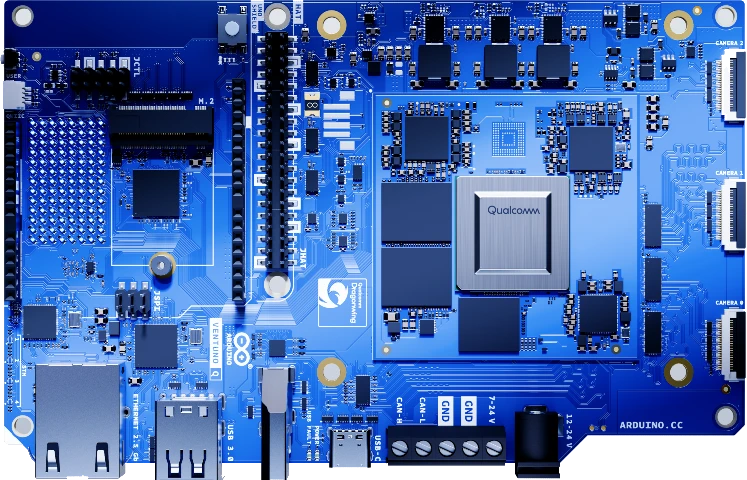
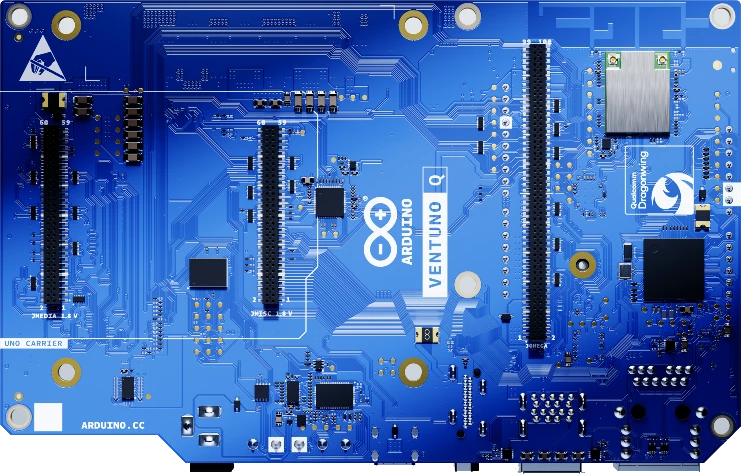
Hardware
Specs
| SoC | Qualcomm Dragonwing IQ8 (IQ-8275) |
|---|---|
| Codename | Monaco |
| CPU | 2× Cortex-A78C (Armv8.2-A) @ 2.35 GHz 2× Cortex-A78C (Armv8.2-A) @ 2.1 GHz 4× Cortex-A55 (Armv8.2-A) @ 1.95 GHz Sold as Kryo Gen 6 |
| Memory | LPDDR5-6400 / LPDDR5X-6400 64-bit Up to 32 GB Inline ECC |
| GPU | Adreno 623 @ 877 MHz Mesa: OpenGL 4.6, OpenGL ES 3.2, Vulkan 1.3 (Freedreno, Turnip, drm/msm kernel) |
| NPU | Hexagon, 40 TOPS dense (INT8) Highest of a 20–40 TOPS range; can differ by binning |
| ISP | Qualcomm Spectra 692 |
| SoC page | QCS8275 / QCS8300 |
Microcontroller
| Microcontroller (MCU) | STM32H5F5 |
|---|---|
| CPU | Cortex-M33 @ 250 MHz |
| Flash | 4 MB |
| RAM | 1.5 MB |
| OS | Arduino core on Zephyr |
Interfaces
| Board | Arduino Ventuno Q |
|---|---|
| Memory | LPDDR5 16 GB |
| Camera | USB camera support, 3× MIPI CSI connectors (muxed with 2× MIPI CSI on JMEDIA) |
| Display | 1× HDMI (muxed with MIPI DSI on JMEDIA), USB-C DP Alt Mode, MIPI DSI pins on JMEDIA header |
| Storage | 64 GB eMMC, M.2 connector for NVMe Gen 4 storage |
| USB | 1× USB 2× USB 3.0 Type-A 2× USB 3.0 (on JOMEGA header) |
| Ethernet | 1× 2.5 GbE (RJ45) |
| Wi-Fi | Wi-Fi 6, 2.4/5/6 GHz, onboard antenna |
| Bluetooth | 5.3, onboard antenna |
| CAN | 5× CAN-FD |
| GPIO | UNO Shield headers, 40-pin header (Raspberry Pi HAT compatible), Qwiic connector (3.3 V, I2C), JMEDIA, JMISC, JOMEGA carrier headers |
| Audio | 2× microphone in / headphone out / ear out / line out on JMISC header |
| Power | USB-C (5 V max @ 3 A) 5.5×2.1 mm power jack (12–24 V DC) Screw terminal (7–24 V DC) 7–24 V on JOMEGA |
| Debugging | JCTL MPU remote debug connector; JTAG on JOMEGA header |
| Dimensions | 160 × 100 × 25.8 mm |
| Weight | 490 g |
| Temperature | -10 °C to +60 °C (commercial range) |
| CAN detail | 1× CAN-FD PHY on screw terminal 3× CAN-FD (no PHY) on JOMEGA header 1× CAN-FD (no PHY) on UNO shield headers |
| Indicators | 4× RGB user LEDs 8×13 blue LED matrix |
| Buttons | User button, reset button |
Available OS images
- Ubuntu
- Debian (Upstream)
- Arduino core on Zephyr (for MCU)
Documentation / Links
Benchmarks
higher is betterRankings
- Single-Core Score #5 of 11 boards · 59 % of Radxa Dragon Q8B981
- Multi-Core Score #4 of 11 boards · 44 % of Radxa Dragon Q8B3,023
higher is betterRankings
- Single-Core Score #5 of 11 boards · 62 % of Radxa Dragon Q8B1,025
- Multi-Core Score #5 of 11 boards · 43 % of Radxa Dragon Q8B2,962
higher is betterRankings
- OpenCL Score #2 of 3 boards · 61 % of Radxa Dragon Q6A1,293
- Background Blur #4 of 4 boards · 25 % of Radxa Dragon Q8B545
- Face Detection #3 of 4 boards · 26 % of Radxa Dragon Q8B539
- Horizon Detection #4 of 4 boards · 8 % of Radxa Orion O6N1,320
- Edge Detection #3 of 4 boards · 38 % of Radxa Dragon Q8B3,526
- Gaussian Blur #3 of 4 boards · 52 % of Radxa Dragon Q8B1,219
- Feature Matching #4 of 4 boards · 11 % of Radxa Orion O6N345
- Stereo Matching #3 of 4 boards · 17 % of Radxa Dragon Q8B4,096
- Particle Physics #3 of 4 boards · 15 % of Radxa Dragon Q8B3,335
Notes
- Qualcomm Adreno (msm): msm hangcheck 250 -> 10000 ms, GPU devfreq governor simple_ondemand -> performance
higher is betterRankings
- Vulkan Score #3 of 4 boards · 13 % of Radxa Orion O6N1,811
- Background Blur #3 of 3 boards · 18 % of Radxa Orion O6N947
- Face Detection #3 of 3 boards · 13 % of Radxa Orion O6N691
- Horizon Detection #3 of 3 boards · 11 % of Radxa Orion O6N2,504
- Edge Detection #3 of 3 boards · 12 % of Radxa Orion O6N2,884
- Gaussian Blur #3 of 3 boards · 12 % of Radxa Orion O6N2,168
- Feature Matching #3 of 3 boards · 10 % of Radxa Orion O6N438
- Stereo Matching #2 of 3 boards · 33 % of Radxa Orion O6N6,870
- Particle Physics #3 of 3 boards · 8 % of Radxa Orion O6N3,760
Notes
- Qualcomm Adreno (msm): msm hangcheck 250 -> 10000 ms, GPU devfreq governor simple_ondemand -> performance
- turnip: tu_restrict_subgroup_size_64=true (Adreno623: maxComputeWorkGroupInvocations 2048 -> 1024, maxComputeWorkGroupSize[0] 1024)
higher is betterRankings
- Background Blur #3 of 3 boards · 17 % of Radxa Orion O6N883
- Face Detection Scored 0: the test failed or did not runFailed
- Horizon Detection #3 of 3 boards · 11 % of Radxa Orion O6N2,663
- Edge Detection #3 of 3 boards · 12 % of Radxa Orion O6N2,917
- Gaussian Blur #3 of 3 boards · 15 % of Radxa Orion O6N2,841
- Feature Matching Scored 0: the test failed or did not runFailed
- Stereo Matching #2 of 3 boards · 36 % of Radxa Orion O6N7,370
- Particle Physics #3 of 3 boards · 7 % of Radxa Orion O6N3,473
higher is betterRankings
- Single-Core Score Only board tested so far846
- Multi-Core Score Only board tested so far3,176
higher is betterRankings
- OpenCL Score Only board tested so far1,079
- Background Blur Only board tested so far1,209
- Face Tracking Only board tested so far1,408
- Feature Matching Only board tested so far983
- Fluid Simulation Only board tested so far1,815
- Horizon Detection Only board tested so far1,150
- Particle Physics Only board tested so far1,482
- Path Tracer Only board tested so far644
- Photo Filter Only board tested so far1,280
- RAW Only board tested so far1,328
- Super Resolution Only board tested so far1,774
- Video Filter Only board tested so far228
Notes
- Qualcomm Adreno (msm): msm hangcheck 250 -> 10000 ms, GPU devfreq governor simple_ondemand -> performance
higher is betterRankings
- Aztec Ruins High (1440p offscreen) #2 of 3 boards · 41 % of Radxa Dragon Q6A672.1
- Aztec Ruins Normal (1080p offscreen) #2 of 3 boards · 76 % of Radxa Dragon Q6A1,854
- Manhattan 3.1 (1080p offscreen) #2 of 3 boards · 78 % of Radxa Dragon Q6Azink2,405native2,057
- T-Rex (1080p offscreen) #1 of 2 boards · 69 % ahead of Radxa Orion O6Nzink5,253native4,788
Notes
- Qualcomm Adreno (msm): msm hangcheck 250 -> 10000 ms, GPU devfreq governor simple_ondemand -> performance
MB/s · higher is betterRankings
- SEQ1M Q8T1Read299.7MB/sWrite175.9MB/s
- SEQ1M Q1T1Read222.1MB/sWrite136.3MB/s
- RND4K Q32T1Read172MB/sWrite88.92MB/s
- RND4K Q1T1Read6.45MB/sWrite5.05MB/s
7-Zip
MIPS · higher is better- Multi-Threaded #2 of 2 boards · 56 % of Radxa Orion O6N15,394MIPS
- Single-Threaded #2 of 2 boards · 80 % of Radxa Orion O6N3,159MIPS
| Cluster | Single-Threaded |
|---|---|
| Cortex-A78Ccpu0–1 · 2.11 GHz | 2,870 |
| Cortex-A78Ccpu2–3 · 2.36 GHz | 3,159 |
| Cortex-A55cpu4–7 · 1.96 GHz | 1,435 |
OpenSSL AES
MB/s · higher is better- AES-256-CBC (16 KiB) #2 of 2 boards · 91 % of Radxa Orion O6N1,325MB/s
| Cluster | AES-128-CBC (16 KiB) | AES-192-CBC (16 KiB) | AES-256-CBC (16 KiB) |
|---|---|---|---|
| Cortex-A78Ccpu0–1 · 2.11 GHz | 1,670 | 1,384 | 1,185 |
| Cortex-A78Ccpu2–3 · 2.36 GHz | 1,864 | 1,546 | 1,325 |
| Cortex-A55cpu4–7 · 1.96 GHz | 1,456 | 1,094 | 901.7 |
Memory bandwidth
MB/s · higher is better- memcpy #2 of 2 boards · 69 % of Radxa Orion O6N12,697MB/s
- memset #2 of 2 boards · 77 % of Radxa Orion O6N36,348MB/s
| Cluster | memcpy | memset |
|---|---|---|
| Cortex-A78Ccpu0–1 · 2.11 GHz | 12,697 | 32,751 |
| Cortex-A78Ccpu2–3 · 2.36 GHz | 12,693 | 36,348 |
| Cortex-A55cpu4–7 · 1.96 GHz | 4,137 | 22,414 |
Memory latency
ns · lower is betterValues per cluster
| Buffer | Cortex-A78Ccpu0–1 · 2.11 GHz | Cortex-A78Ccpu2–3 · 2.36 GHz | Cortex-A55cpu4–7 · 1.96 GHz |
|---|---|---|---|
| 4 KiB | 1.91 | 1.7 | 1.04 |
| 8 KiB | 1.91 | 1.7 | 1.04 |
| 16 KiB | 1.91 | 1.7 | 1.04 |
| 32 KiB | 1.91 | 1.71 | 1.06 |
| 64 KiB | 5.79 | 5.18 | 9.57 |
| 128 KiB | 5.76 | 5.18 | 13.76 |
| 256 KiB | 7.24 | 6.71 | 14.87 |
| 512 KiB | 7.49 | 6.76 | 23.84 |
| 1 MiB | 7.81 | 7.03 | 114.7 |
| 2 MiB | 8.35 | 7.69 | 136.1 |
| 4 MiB | 39.32 | 36.27 | 143.2 |
| 8 MiB | 100.6 | 91.28 | 158.3 |
| 16 MiB | 138.6 | 136.1 | 162.8 |
| 32 MiB | 155.3 | 153.7 | 167.2 |
| 64 MiB | 172.4 | 168.8 | 173 |
| 128 MiB | 176.4 | 172.1 | 178.2 |
cpuminer
kH/s · higher is better- cpuminer #2 of 2 boards · 55 % of Radxa Orion O6N24.95kH/s
Guides
No guides available yet.