Arduino Ventuno Q First Look: Benchmarks, Specs and Mainline Linux
 Sunday, 15 March 2026 - 16:30
Estimated reading time: 10 minutes
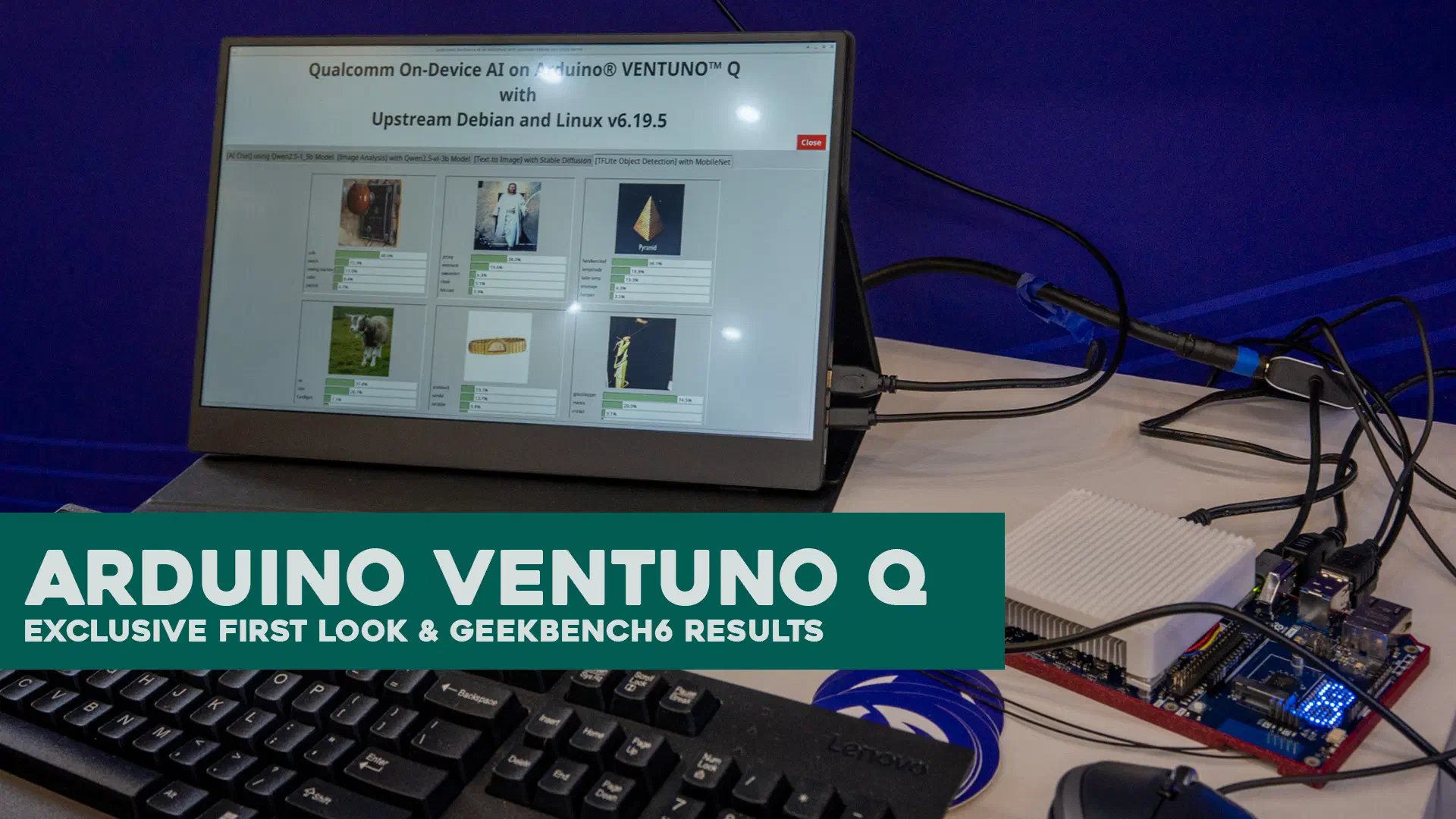
I had the opportunity to see and test Arduino’s new Ventuno Q board at Embedded World 2026 in Nuremberg. This is the second product following Qualcomm’s acquisition of Arduino and once again combines a Dragonwing SoC with an STM32 microcontroller like the Arduino Uno Q. But unlike the Uno Q which is the entry level product in this line-up, the Ventuno Q would target the mid to higher tier of Single Board Computers.
If you are not familiar with the Dragonwing SoCs I’m going to explain it to you in this following section. First we have every SoC starting with the prefix QC- following an -S (standalone) or -M (includes modem for 4G / 5G connectivity). There are also the IQ6, IQ8 and IQ9 series which are defined as the industrial solutions and you will find IQ- and QCS- used interchangeably for most of these SoC variants.
Most of the Dragonwing SoCs are derivatives of either mobile or automotive grade chips with certain features fused off (probably due to binning) or just rebranded variants for the industrial market.
Arduino Ventuno Q Specs and Hardware Overview#
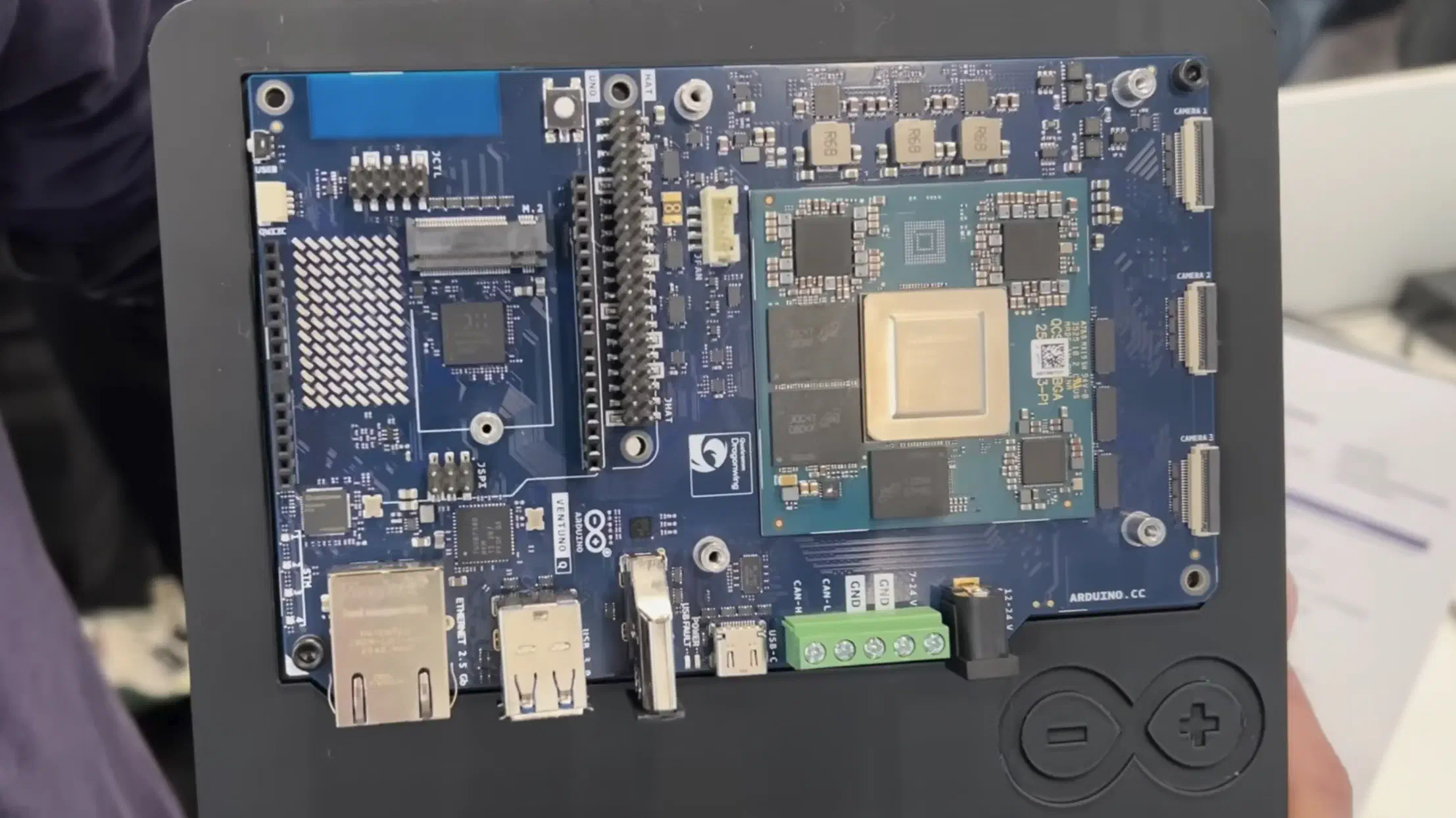 Arduino Ventuno Q without Heatsink Source
The Ventuno Q features a dual-brain (MPU & MCU) architecture that separates general compute / AI inference from low-latency actuation.
Specs#
| Arduino Ventuno Q | Details |
|---|---|
| Microprocessor (MPU) | Qualcomm Dragonwing IQ8 (IQ-8275): • CPU: Octa-core Arm Cortex • Adreno GPU/VPU: Arm Cortex A623 at 877 MHz • Hexagon Tensor AI Processor (NPU): up to 40 dense TOPS • Qualcomm Spectra 692 ISP |
| OS | Ubuntu or Debian upstream |
| Microcontroller (MCU) | STM32H5F5: • Arm Cortex M33 at 250 MHz • 4 MB flash • 1.5 MB RAM |
| OS (MCU) | Arduino core on Zephyr |
| RAM | 16 GB LPDDR5 |
| Storage | • 64 GB eMMC • M.2 connector for NVMe Gen.4 external storage |
| Connectivity | • Wi-Fi 6 2.4/5/6 GHz with onboard antenna • Bluetooth 5.3 with onboard antenna • 1× 2.5 Gbit RJ45 |
| Camera | • USB camera support • 3× MIPI CSI connectors muxed with 2× MIPI CSI on JMEDIA header |
| Video | • 1× HDMI muxed with MIPI DSI on JMEDIA header • Video output (DP Alt mode) support via USB-C • MIPI DSI pins on JMEDIA header |
| Audio | 2× Microphone IN / Headphone OUT / Ear OUT / Line OUT on JMISC header |
| Power Supply | • From USB-C connector 5 VDC max at 3 A • 5.5×2.1 mm Power Jack 12–24 VDC • Screw Terminal 7–24 VDC • 7–24 V on JOMEGA |
| USB | • 1× USB-C port with host/device role switching, power role switch and video output • 2× USB 3.0 Type A • 2× USB 3.0 on JOMEGA header |
| CAN | • 1× CAN-FD PHY on screw terminal • 3× CAN-FD (no PHY) on JOMEGA header • 1× CAN-FD (no PHY) on UNO Shield headers |
| Dimensions | 160×100×25.8 mm |
The two processors communicate via an RPC bridge: the Qualcomm side runs Linux with the focus on AI workloads, while the STM32 runs Arduino Core on Zephyr for real-time control. The board can run as a standalone desktop or connect to a PC over USB-C or Ethernet for development.
Hardware Impressions#
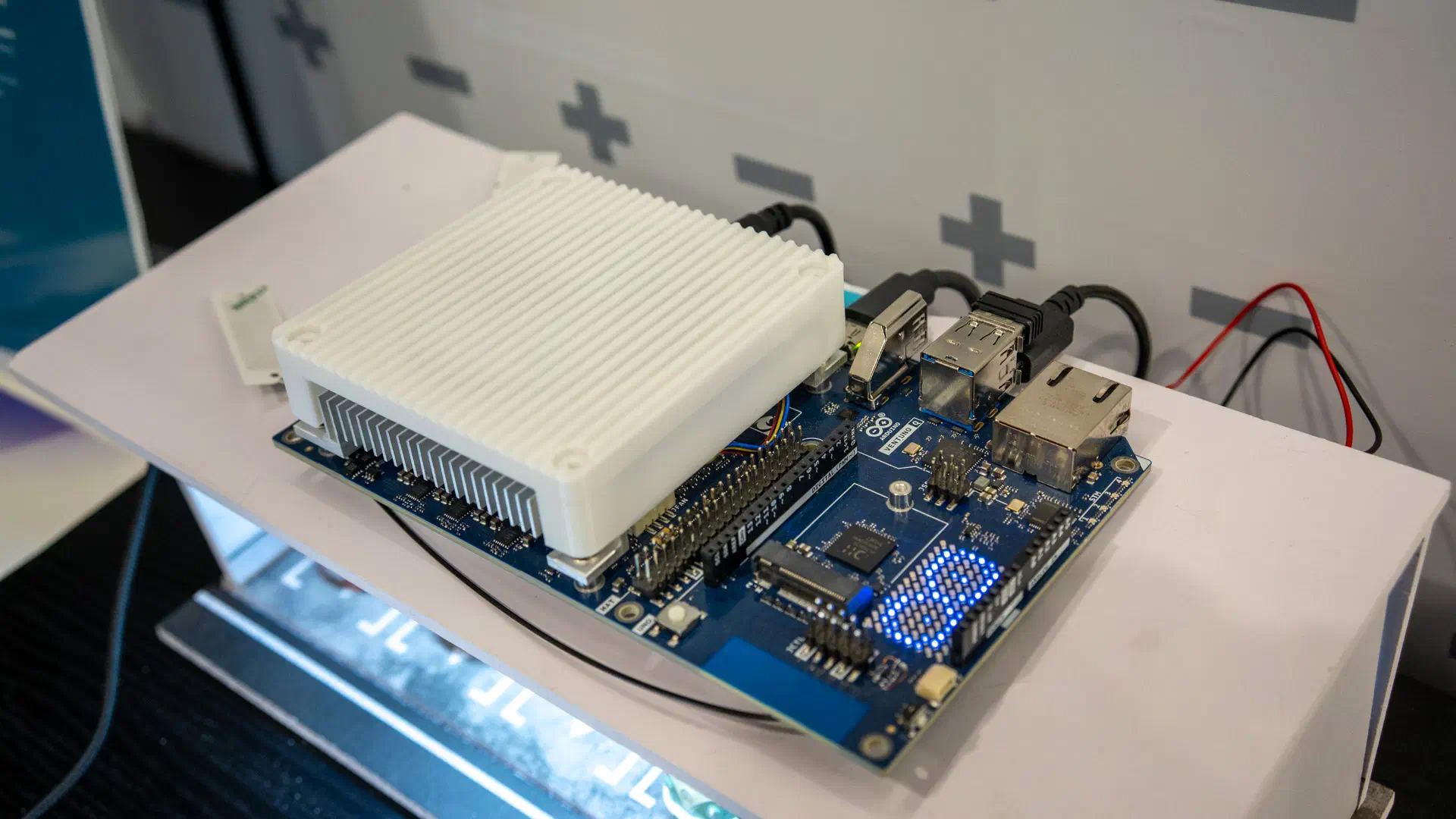 The heatsink of the Ventuno Q has a 3D-Printed cover
Something that confused me at first was the cover on the heatsink. It turns out for the Expo they had to fall back to using a fan while final units are supposed to run completely passive. I’m happy to see that this is being worked on and that this board compared to the Uno Q has plenty of I/O in the form of a dedicated HDMI port for video, 2.5GbE Network connectivity as well as an M.2 connector so one does not have to rely on the internal EMMC storage which with years of deployment will wear out over time. I also like that there is an internal LED Matrix on it which makes it interesting in the education context as students can have something to “easily” achieve their first microcontroller experience with that is reflected in the real world with their code without needing additional hats.
Compared to the Leonardo, with which I had my first experience with Arduino in 2016, this board is obviously in a different league but with compute becoming more accessible (ignoring the DRAM crisis right now) Qualcomm and Arduino are making an interesting case for this class of dual brain SBCs. And I’m glad that even with DRAM prices making for tough choices currently they still opted to ship this SBC with 16GB of LPDDR5 so you can try out more than the smallest AI models and even make the case of this SBC for Desktop usage.
Benchmarks#
But now to how well it fares and for that we can look at the following GeekBench 6 benchmarks I was able to run on the show floor.
The board and software shown are pre-release and not optimised to reflect the best performance possible. Specifications and results may change until release.
CPU Benchmark#
Single Core#
Geekbench 6 Single Core performance
What we can see here is that besides for the Uno Q with its QRB2210 SoC these Dragonwing SoCs use the same Kryo Gold cores which are just regular A78 cores leading to roughly the same single core scores across QCS6490, IQ8 and IQ9 with the differences being just test variance.
Multi Core#
Geekbench 6 Multi Core performance
Here we can see a different story play out. The Ventuno Q (IQ8) and QCS6490 more or less have the same big / little core strategy therefore the performance differences are negligible and they play in the same class. The IQ9 series on the other hand uses an all big core layout and this we can see with a roughly 2x score in this benchmark.
Also the Qualcomm RB4 (Codename: Monaco) Evaluation Board with the same SoC has a public Geekbench 6 result which shows it achieving a multi core score of 3418 further highlighting that there is some room left open on the top end.
Arduino makes a clear separation to their entry level Uno Q with the performance of these boards and I hope this does not mean a 6x price increase since comparable performance boards are hovering around the $130-150 range for variants which are also using 16GB of LPDDR5 RAM.
GPU Benchmark#
Here I’m not able to give this board a fair comparison as the Ventuno Q I had access to on the show floor was not only using an older version of Mesa (25.2.6) with the Freedreno driver not yet optimised for the Adreno 623 GPU inside the IQ8. This also meant some benchmarks failed not giving us a proper score which would probably not happen on Mesa 26.x and newer.
Yet these are the individual results I was able to gather:
Geekbench 6 GPU (Vulkan): Ventuno Q
Compared to QCS6490 with Adreno 643:
Geekbench 6 GPU (Vulkan): QCS6490
Looking at the Stereo Matching score we see the Ventuno Q be ahead while the QCS6490 seems to lead in all other Vulkan benchmarks. To be fair we are comparing the unfinished open source Freedreno driver to Qualcomm’s proprietary driver here so we have to wait until we get the board into our own hands to make an actual fair comparison.
Beyond CPU & GPU performance#
We see that the IQ8 inside the Ventuno Q does position itself above the QCS6490. With 3.5x the NPU performance the Ventuno Q will be able to run LLM models which the QCS6490 based boards are not able to do next to image / speech recognition tasks which both are able to do.
Also in terms of video processing the IQ8 is ahead of the QCS6490 by also supporting AV1 decoding and just in general more than 2x the FPS in decoding and encoding tasks allowing the use of for example more cameras for ai processing tasks and outputting many video streams at once. This will be interesting to try out for open source NVR solutions like Frigate.
| Feature | QCS6490 | IQ8 (QCS8275) |
|---|---|---|
| VPU Decode | 4K@60fps (H.264, H.265, VP9) | 4K@135fps (AV1, H.265, H.264, VP9) |
| VPU Encode | 4K@30fps (H.264, H.265) | 4K@85fps (H.264, H.265) |
| Hexagon NPU | Up to 12 TOPS | 40 INT8 TOPS (Dense) |
Power Consumption & Thermals#
We do not have power consumption numbers yet and as previously mentioned the show floor model was using a fan to run the tasks we threw at it. Here we also have until I get the final Ventuno Q inside my testing lab (aka my desk at home).
Mainline Linux support#
Now to the topic that really solidifies my stance to what Qualcomm and its subsidiaries and partners are pushing. The main reason the board is not on sale yet is that the teams behind this product are putting in the work sending in patches every day to the mailing list, getting the lawyers and developers to open up every subsystem one by one and then upstreaming those which is a whole undertaking on its own. I am sure that when this board actually comes on sale we will have every relevant aspect in the mainline Linux kernel and not just the Qualcomm-Linux BSP. So projects like Armbian will be able to follow up with their own releases for it.
As the product page already says it will run upstream Debian I do not have any doubt they will achieve that until then. But when it comes to the bootloader we will have to wait and see if by the time of release Qualcomm’s closed EDK2 will be public too but even until that happens upstream U-Boot already has support for this chip and I was able to confirm it working on my IQ9 based Radxa Airbox Q900 board.
You can see on the linux-msm status page that this SoC already has lots of its drivers already inside mainline Linux since 6.14 and the rest is being sent day by day.
Arduino Software#
Arduino provides its App Lab which is a unified development across sketches, Python scripts, and AI models. It should be an easy entry for first time users of the Qualcomm development stack but as the Uno Q reviews showed they also have lots of bugs to fix until the release of this board.
FAQ: Arduino Ventuno Q#
The Arduino Ventuno Q is a dual-brain single board computer that combines a Qualcomm Dragonwing IQ8 application processor with an STM32 microcontroller for real-time control tasks.
In the pre-release Geekbench 6 runs shown here, Ventuno Q is far ahead of Uno Q and lands close to QCS6490 in CPU performance, while GPU results are still affected by early Mesa/Freedreno driver maturity.
Arduino positions the board for upstream Debian and Ubuntu, and ongoing Linux mainline enablement for the SoC platform suggests broad Linux support at launch and beyond.
For on-device AI inference, IQ8 in Ventuno Q has a much stronger NPU specification than QCS6490, which should make larger local AI and multi-stream vision workloads more practical.
Conclusion & Outlook#
The Ventuno Q represents a notable step in Qualcomm’s open source strategy and and how Arduino will establish itself not just as a microcontroller company but also a Single Board Computer vendor. They will have lots of competition but they’re also playing the long game against Raspberry Pi (and therefore Broadcom) with a more open approach that will put pressure on the entire market and might even eat parts of Intel’s edge share. In the end only time as well as price will tell but one thing is clear the old proprietary Qualcomm is gone and this is a new era they are stepping into.
Here you can find the official Arduino Ventuno Q product page.
If you liked this article you can subscribe to our RSS feed and follow us on X/Twitter for the latest news in the embedded space! I’m trying to bring you guys the most transparent articles and this is taking lots of time to do therefore I’m looking forward to your comments and am interested in the discussions that come out of it.
Author: Mecid Urganci
I'm a full time Applied Cognitive and Media science student who in his free time loves to tinker. This sparked an interest in embedded hardware, which I try to make more accessible with this platform I created "SBCwiki".You can find me on X/Twitter at @mecoscorner and GitHub at @HeyMeco